
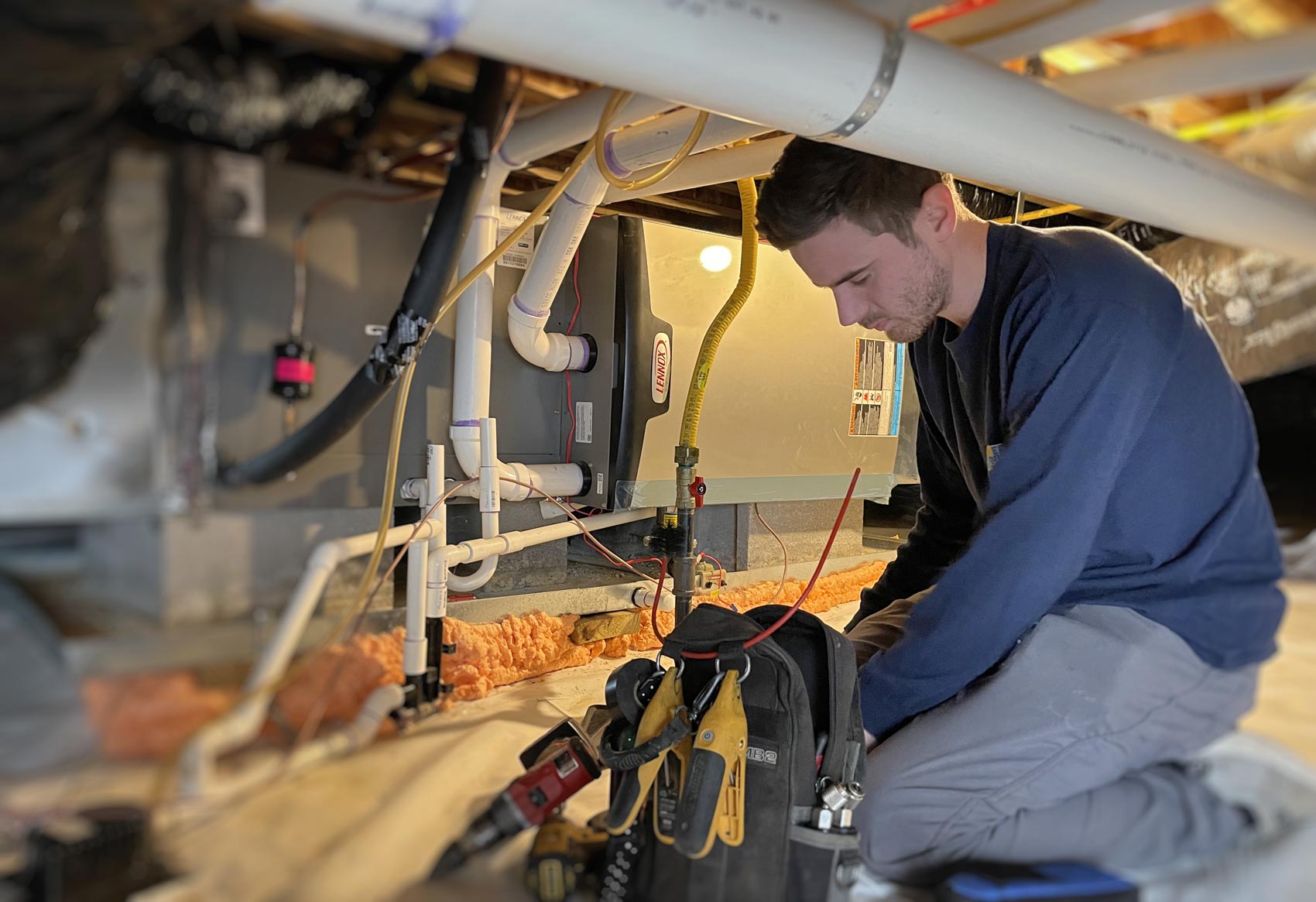
A technician who finds a cracked heat exchanger will usually shut your furnace off and hand you a replacement quote. Here’s what a crack is, how it should be proven, when a second opinion makes sense, and how to weigh a repair against a new furnace.
What is a cracked heat exchanger?
A cracked heat exchanger is a split or hole in the metal chamber inside a gas furnace that keeps the burner flames and exhaust apart from the air your blower sends through the house. When the chamber is sound, exhaust, including carbon monoxide, leaves through the flue. A crack breaches that wall, so exhaust can mix with the air you breathe. Most cracks come from years of heating up and cooling down, and they come sooner in a furnace that’s oversized, short-cycles, or runs with a clogged filter. Gas furnaces, gas packs and the furnace half of a dual-fuel system all have one.
What are the signs of a cracked heat exchanger?
The clearest sign is a carbon monoxide alarm that sounds while the furnace is running. Most cracks show nothing a homeowner can see, which is why they’re usually found during a tune-up or a repair call. Other warning signs:
- Headaches, dizziness, nausea or sleepiness that ease when you leave the house
- Burner flames that turn yellow, flicker, or jump when the blower starts, instead of burning steady and blue
- Soot or rust around the burners or on top of the furnace
- A sharp, chemical smell while the heat runs
If your carbon monoxide alarm goes off, get everyone outside and call 911. Then call us before the furnace runs again.
How does a technician confirm a crack?
A technician confirms a crack with more than one test: a direct look at the heat exchanger, a check of the burner flames when the blower starts, and carbon monoxide readings in the flue and at the supply vents. A real crack often makes the flames move or roll the moment the blower kicks on. A combustion analyzer then shows whether exhaust is reaching the air in your ducts.
A camera picture alone is a thin basis for a replacement, because a camera only shows the surfaces it can reach. Ask to see the crack yourself, or for a clear photo or video of it, before you sign anything.
Is it safe to run a furnace with a cracked heat exchanger?
No. Once a crack is confirmed, the furnace should stay off until the heat exchanger or the furnace is replaced. Some cracks leak carbon monoxide only under certain conditions, so a low reading on one visit doesn’t make a confirmed crack safe. That’s why a technician who finds one will usually shut the furnace down and put a “red tag” on it, a do-not-operate notice for an appliance they consider unsafe.
If you smell gas, leave the house first, then call 911 and Enbridge Gas North Carolina at 877-776-2427 from outside.
When does a second opinion make sense?
A second opinion makes sense when the diagnosis rests on a single test, nobody can show you the crack, or you’re being pushed to buy a new system that day. It also makes sense when the furnace is young or still under warranty, since that changes the math (see the table below). Let the second technician run their own tests before you share the first report.
A customer in exactly that spot wrote: “Our regular HVAC company told us that our upstairs furnace had cracks in the heat exchanger. They were pressuring us to buy a new system right that minute.” Johnny Hayes, one of our senior technicians, tested the furnace and found no carbon monoxide leaking. “He came back a second time with a more sensitive detector and still could not find any leaks,” she wrote. “He saved us a ton of money.”
Whoever you call, check that they hold a North Carolina heating license. The State Board of Examiners of Plumbing, Heating and Fire Sprinkler Contractors licenses HVAC contractors, and its license search lets you look up any company or technician by name.
Should you replace the heat exchanger or the whole furnace?
Replace the heat exchanger when the furnace is fairly young and the part is still under warranty. Replace the furnace when it’s past about 15 years old, out of warranty, or has needed other major repairs. Nationally, a heat exchanger swap usually runs about $1,000 to $3,000 out of warranty. A warranty covers the part, not the labor, and labor is most of the job. Trane, for example, warranties its furnace heat exchangers for 20 years.
| Question | Lean toward a new heat exchanger | Lean toward a new furnace |
|---|---|---|
| How old is the furnace? | Under about 10 years | Over about 15 years |
| Is the heat exchanger under warranty? | Yes, you pay mainly labor | No, you pay parts and labor |
| Other major repairs lately? | None | Two or more in recent seasons |
If you’re replacing the furnace, it’s also a chance to compare a new furnace with replacing a gas furnace with a heat pump.
Frequently Asked Questions
Can a cracked heat exchanger be welded or patched?
No. A cracked heat exchanger on a home furnace is replaced, not welded or sealed, because a patch won’t hold up through thousands more heating cycles. The choice is a new heat exchanger or a new furnace.
Will a carbon monoxide alarm catch a cracked heat exchanger?
Often, but not always. A carbon monoxide alarm sounds when levels build up, not at the first trace, so it’s a last line of defense rather than an inspection. Put alarms on every level of the home and outside sleeping areas, and test them monthly. Our guide to carbon monoxide detectors covers placement.
Does a heat pump have a heat exchanger that can crack?
No combustion one. A heat pump moves heat with refrigerant and backs it up with electric heat strips, so there’s no flame and no exhaust. If your home has a heat pump paired with a gas furnace, the furnace side still has a heat exchanger and needs the same checks.
Get a Second Look From Boer Brothers
Boer Brothers Heating & Cooling inspects and repairs gas furnaces across Chapel Hill, Durham, Cary and the rest of the Triangle. If you’ve been told your heat exchanger is cracked and want it checked, call 919.813.2556 or see our heating repair services.
Related posts
 Heating

